Key Takeaways
Assessment
Assessment questions focused on pre-award activities (market research, solicitations, proposal evaluation) and post-award activities (contract clauses, defect escalation, and verification of deliverables).
Components answered these questions only if they performed acquisition and procurement activities independently or in addition to their parent agency. Sixty agencies and 110 components provided responses.
Findings
To reduce accessibility issues during or after implementation, agencies must integrate Section 508 requirements throughout the procurement lifecycle and carry them through delivery, testing and acceptance. This helps ensure vendors and procurement officials remain accountable for accessibility throughout the ICT lifecycle. When agencies do not integrate Section 508 into procurement, they face predictable risks, including:
The average agency Acquisition and Procurement factor outcome was 3.44 (High) on a 5-point scale, with outcomes ranging from 0 to 5.
Components from 10 agencies reported similar results. Of the 110 components that perform acquisition and procurement activities independently or in addition to the Agency, the average component outcome was 3.72 (High), ranging from 0.42 to 5. Their 10 parent agencies reported an average outcome of 4.02 (Very High).
Among the agencies that perform acquisition activities, 31 (56 percent) reported mostly or fully integrating ICT accessibility into acquisition and procurement policies and functions.
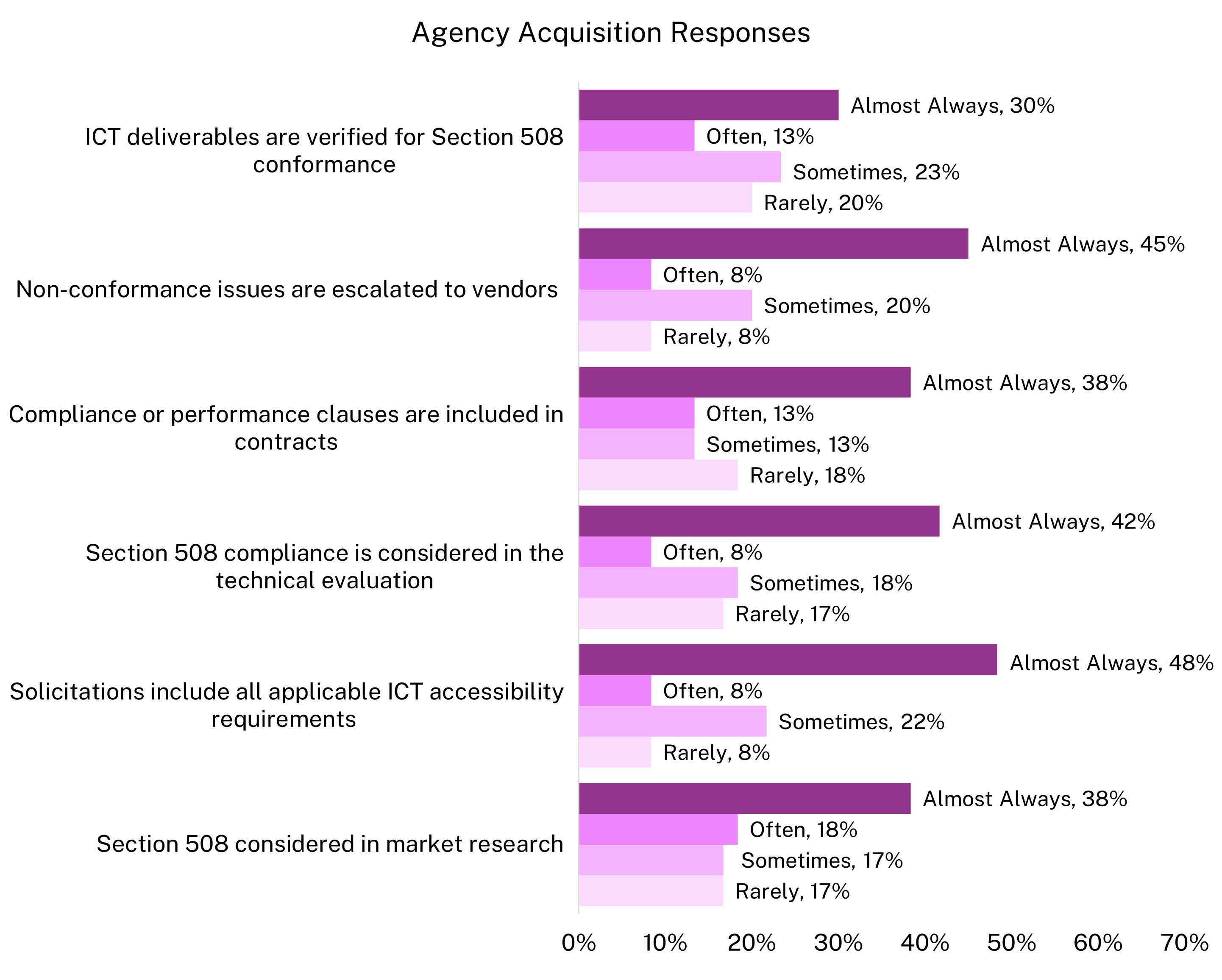
Response data show a consistent pattern: agencies more often include Section 508 requirements than verify and enforce them. This gap between requirements-setting and follow-through limits vendor accountability and increases the likelihood that nonconformant ICT is accepted. Additional context:
| Frequency | Section 508 compliance is considered in market research | ICT solicitations include all applicable ICT accessibility requirements | Section 508 compliance is considered in the technical evaluation of ICT | Compliance or performance clauses are included in contracts to ensure vendor accountability | Nonconformance issues are escalated to vendors or contractors when found | ICT deliverables from a contract are verified for Section 508 conformance |
|---|---|---|---|---|---|---|
| Never (0%) | 3% | 7% | 8% | 10% | 12% | 7% |
| Rarely (1%-10%) | 17% | 8% | 17% | 18% | 8% | 20% |
| Sometimes (11%-50%) | 17% | 22% | 18% | 13% | 20% | 23% |
| Often (50%-90%) | 18% | 8% | 8% | 13% | 8% | 13% |
| Almost always (≥90%) | 38% | 48% | 42% | 38% | 45% | 30% |
| N/A – does not perform activity | 7% | 7% | 7% | 7% | 7% | 7% |
Overall, component-level acquisition practices mirror parent agencies’: components more consistently set requirements than verify and enforce them (Table 8).
On average, 62 percent of components reported “often” or “almost always” performing each assessed activity, comparable to 65 percent for parent agencies. Components demonstrated stronger performance in including accessibility requirements in solicitations: 74 percent reporting “often” or “almost always” doing so, compared to 60 percent of parent agencies.
Components and parent agencies reported similar outcomes in technical evaluations: 62 percent of components and 60 percent of parent agencies reported “often” or “almost always” considering Section 508 prior to award. Components lagged behind parent agencies in market research: 61 percent of components report they “often” or “almost always” consider Section 508 compared to 70 percent of parent agencies.
Both groups reported comparable performance in verification of deliverables: 56 percent of components and 60 percent of parent agencies reported “often” or “almost always” verifying deliverables. However, many components selected “sometimes” or “rarely” across multiple activities, indicating inconsistent application of accessibility requirements, an inconsistency also reflected in agency-level responses.
Components continue to struggle with contract management and enforcement. Only 21 percent of components reported “often” escalating nonconformance issues to vendors. Parent agencies reported stronger escalation practices, with 50 percent indicating they “almost always” escalate accessibility issues and 20 percent reporting they “often” do.
Taken together, components frequently include accessibility requirements and participate in key acquisition steps, but inconsistent verification and enforcement continue to limit effective Section 508 implementation across the acquisition lifecycle.
| Frequency | Section 508 compliance is considered in market research | ICT solicitations include all applicable ICT accessibility requirements | Section 508 compliance is considered in the technical evaluation of ICT | Compliance or performance clauses are included in contracts to ensure vendor accountability | Nonconformance issues are escalated to vendors or contractors when found | ICT deliverables from a contract are verified for Section 508 conformance |
|---|---|---|---|---|---|---|
| Never (0%) | 1% | 0% | 3% | 4% | 5% | 6% |
| Rarely (1%-10%) | 10% | 6% | 11% | 11% | 9% | 11% |
| Sometimes (11%-50%) | 23% | 13% | 17% | 15% | 20% | 22% |
| Often (50%-90%) | 27% | 26% | 23% | 25% | 21% | 27% |
| Almost always (≥90%) | 34% | 47% | 39% | 37% | 39% | 29% |
| N/A – does not perform activity | 5% | 7% | 7% | 9% | 6% | 5% |
Agencies that more fully integrate ICT accessibility into acquisition and procurement policies and functions report higher acquisition factor outcomes than agencies with less integration. Agencies reporting full integration averaged 4.74 (Very High), compared to 1.63 (Low) for agencies reporting no integration.
Acquisition outcomes do not correlate meaningfully with conformance results of tested ICT (c-index) or Testing and Remediation outcome, indicating that stronger acquisition alone does not ensure accessible outcomes without validation and follow-through.
Components show a similar pattern: stronger integration is generally associated with better acquisition outcomes. However, a notable exception exists: the moderately integrated group averaged 2.87 (Moderate), lower than the somewhat integrated group. Components reporting full integration averaged 4.36 (Very High), compared to 2.76 (Moderate) for components that reported no integration of accessibility into acquisition policies and functions. Components’ Testing and Remediation outcomes do not correlate strongly with their Acquisition and Procurement outcomes.
Exceptions
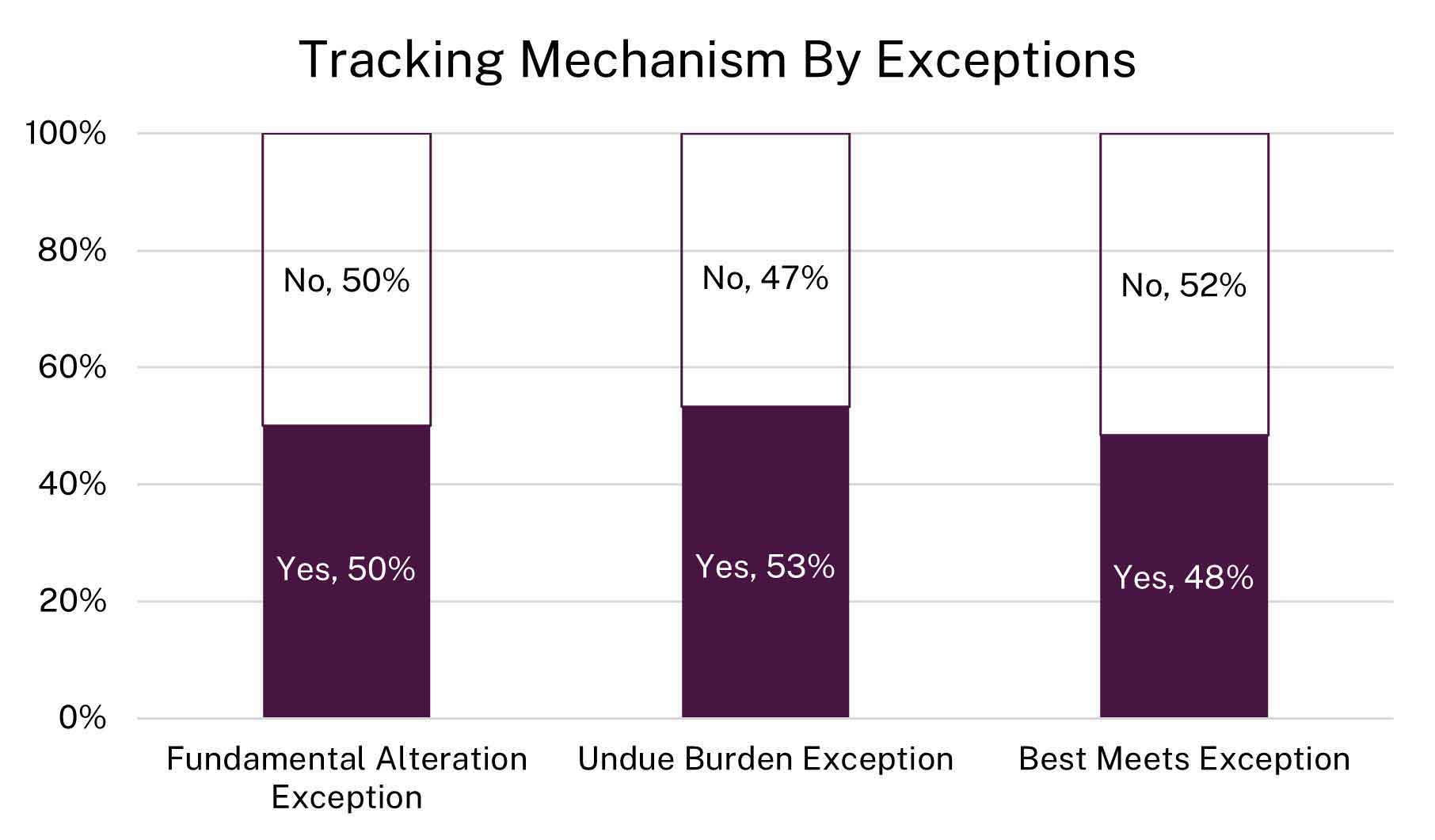
The assessment asked agencies and components whether they track “Fundamental Alteration,” “Undue Burden,” and “Best Meets” exceptions, how many are currently authorized, and whether they create and maintain required alternative means plans.
Responses reveal a significant governmentwide gap. Approximately half of agencies and more than half of components reported no tracking process for these exceptions (Figure 9). Compounding this gap, approximately 67 percent of agencies and more than 70 percent of components reported that they do not create or maintain alternative means plans.
Agencies and components reported totals for currently authorized exceptions. Best Meets accounts for the highest volume of these authorized exceptions.

Total Authorized Fundamental Alteration Exceptions

Total Authorized Undue Burden Exceptions

Total Authorized Best Meets Exceptions
Best Practices and Remaining Challenges
Over the past year, some agencies strengthened the integration of Section 508 requirements into acquisition processes by updating contract language, improving exception and exemption documentation, and formalizing request evaluation procedures. Agencies that integrated accessibility reviews into Federal Information Technology Acquisition Reform Act (FITARA) processes, authorization to operate (ATO) workflows, and software request procedures gained significantly improved early visibility into accessibility risks. Centralizing IT acquisition reviews, automating Section 508 checklists, and strengthening market research using accessibility conformance reports (ACRs) supported more consistent oversight. These practices strengthen day-one accessibility expectations, help identify non-compliant solutions earlier, and support more effective vendor engagement.
However, substantial challenges remain. Agencies reported inconsistent adoption of Section 508 contract language and uneven leadership support for enforcement. Vendor accessibility claims remain difficult to validate, and limited shared guidance and tools hinder more uniform implementation. Many digital services and IT systems still enter production without required accessibility testing, increasing remediation costs and compliance risks. Limited capacity, growing review demands, and tooling needs continue to strain acquisition and compliance teams. Strengthening accountability, standardizing post-award controls, and improving vendor oversight are essential next steps to ensure accessible technology acquisitions.
Reviewed/Updated: March 2026