Key Takeaways
Assessment
The FY 2025 assessment criteria included questions about agencies’ Section 508 programs, such as:
GSA collected data from 60 agencies; 152 components from 12 of those agencies show varied responses governmentwide.
Findings
A strong Section 508 program helps agencies meet statutory requirements and ensures that individuals with disabilities can access ICT products and digital services. Prioritizing ICT accessibility allows agencies to standardize development and procurement processes, reduce rework, improve efficiency, and keep projects on schedule. Clear Section 508 policies set expectations, support accountability, and contribute to a more effective procurement and development lifecycle.
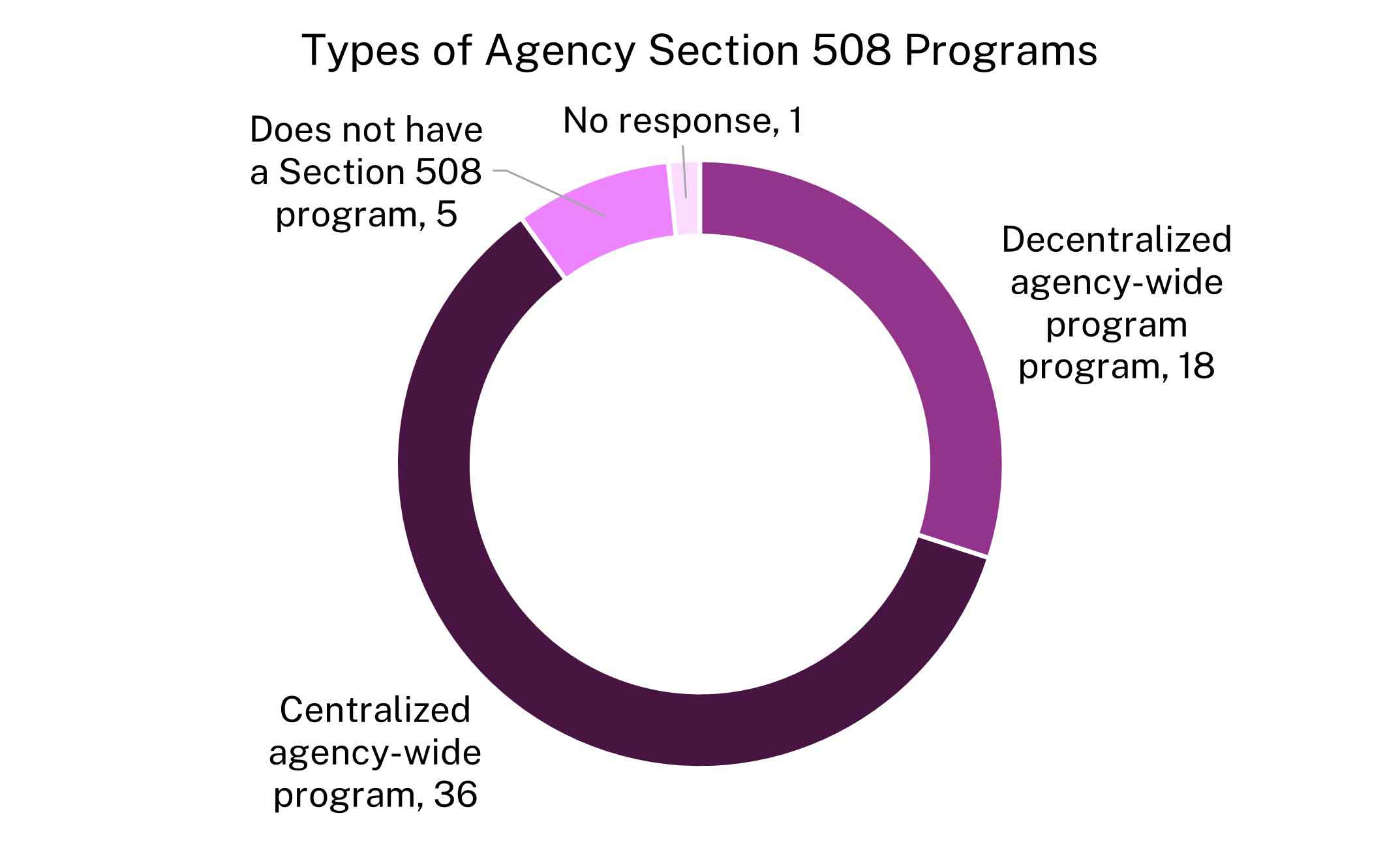
Most agencies report having a Section 508 program, but program structures vary and directly affect implementation and accountability. Of the 60 reporting agencies, 54 reported having a Section 508 program. Among these, 36 agencies operate centralized programs, while 18 operate decentralized programs. This structural variation shapes how accessibility responsibilities are managed and enforced across the enterprise.
Decentralized models rely heavily on component-level execution. Across 11 agencies, 115 components reported having their own Section 508 programs, indicating that much of the day-to-day accessibility work occurs at the component level rather than solely within an agency-wide program. As a result, the effectiveness of Section 508 implementation depends on how well these component programs are resourced, coordinated, and aligned with agency-wide policies and oversight mechanisms.
Strengthening governance frameworks to connect agency-wide leadership with component-level execution is critical to achieving consistent, scalable, and accountable ICT accessibility outcomes across the federal government. See Figure 14 for a breakdown of program structures across agencies.
Staffing
Both agencies and components provided data on Section 508 PM designation, time spent supporting Section 508 efforts, Section 508 staffing and contractor resources, and Section 508-related training. Responses varied across respondents in each category.
Responses from 60 agencies shows:
Responses from 152 components from 12 parent agencies shows:
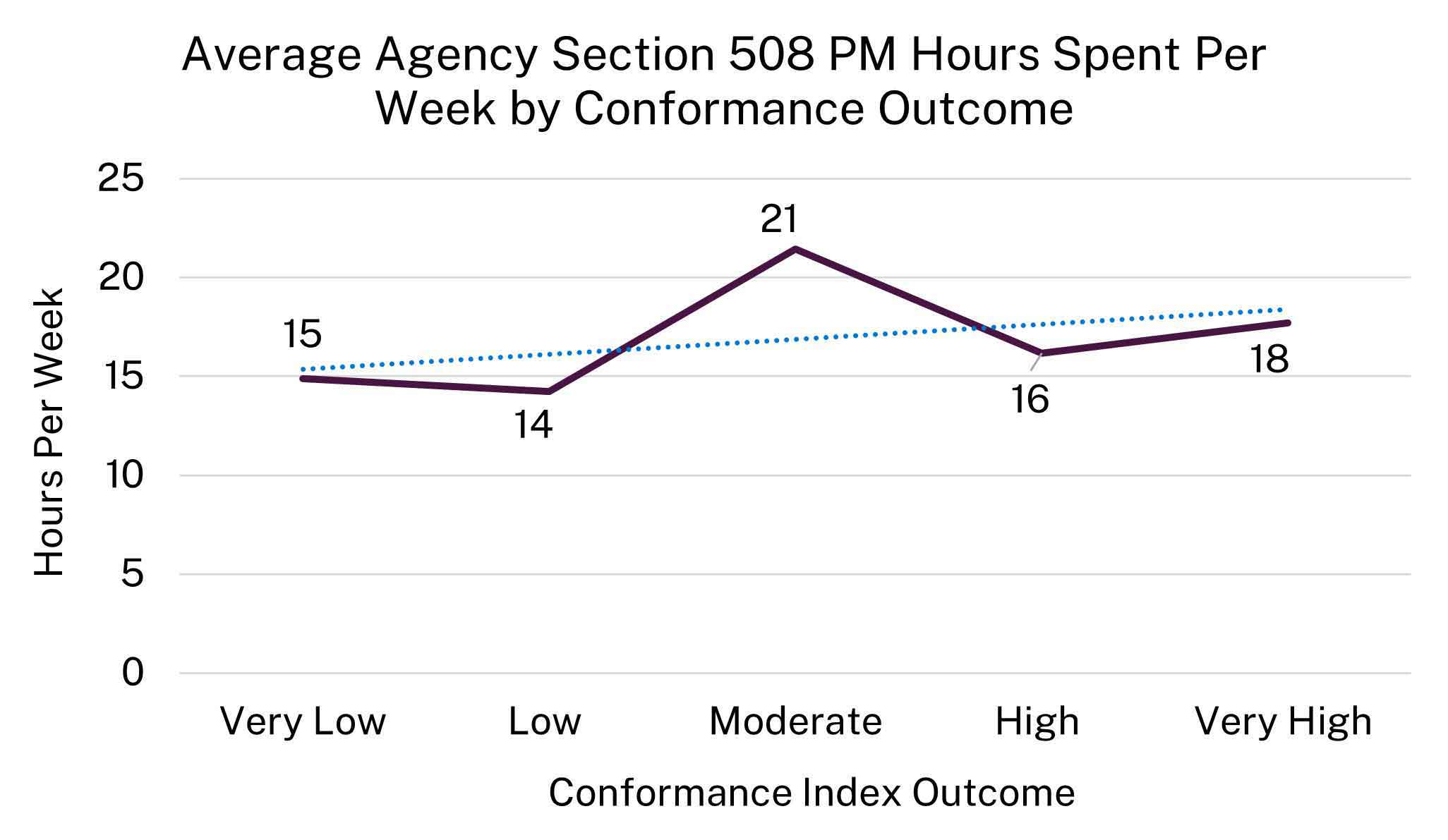
Taken together with conformance outcomes, Figure 15 shows that there is a slight positive relationship between the average hours per week an agency Section 508 PM dedicates to program activities and the conformance outcomes for that agency. Agencies tend to have more conformant ICT when the Section 508 PM can dedicate more time to the Section 508 program.
Agency Staffing
Among the 60 agencies:Component Staffing
Across 152 components from 12 parent agencies:Management of ICT Accessibility Across the Agency
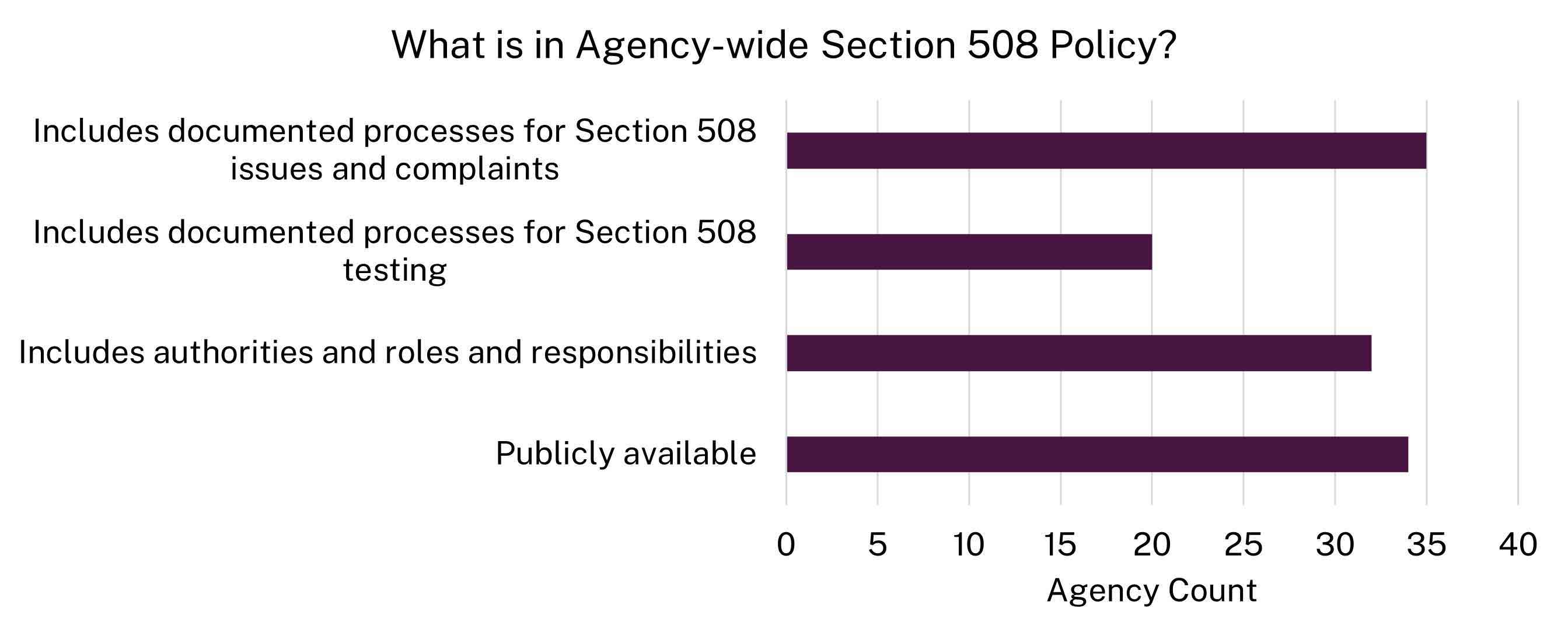
A Section 508 or ICT accessibility policy provides the governance foundation agencies need to comply with federal accessibility requirements. It defines authorities, roles, responsibilities, expectations, and processes that ensure ICT accessibility is embedded across procurement, development, content creation, and IT operations. Most agencies have a Section 508 policy, but not all:
Of the 48 that have a policy:
All 12 agencies with components reported having an agency-wide Section 508 or ICT accessibility policy. Eighty-eight components, or 58 percent, reported having a component-level Section 508 or ICT accessibility policy in addition to the agency-wide policy.
Submitted data illustrate how agencies and components allocate staff, contracting, and technical resources to Section 508 compliance:
Training
Effective Section 508 implementation depends on a workforce that understands ICT accessibility requirements and how to apply them throughout the ICT lifecycle. Responsibility for accessibility spans acquisition staff, designers, developers, testers, content authors, and program managers. Without consistent training, agencies incur higher remediation costs and continue to deploy inaccessible technology and digital content.
Assessment results show that enterprise-wide Section 508 training is uncommon. Only 16 agencies (27 percent) and 38 components (25 percent) reported mandatory Section 508 training, meaning that roughly 75 percent of federal agencies lack a baseline requirement for accessibility awareness or skills.
Even when training is required, frequency is inconsistent. Among the 16 agencies with mandatory training, most require annual training, but the others require only one-time or irregular training. Component-level responses show a similar pattern, with variation in whether training is annual, one-time, or unspecified. Some components require Section 508 training, even when their parent agencies do not, creating inconsistent standards within the same agency.
Role-specific training is also limited, despite its importance to compliance. Only a minority of agencies require additional training for key roles:
Overall, 55 percent of agencies require none of these groups to take role-specific Section 508 training, despite their direct responsibility for accessibility implementation and conformance outcomes. Component-level data reflects a nearly identical pattern.
Complaints
Under Section 508 of the Rehabilitation Act (29 U.S.C. § 794d(f)(2)), agencies receiving Section 508 complaints must apply the complaint procedures established under Section 504 for resolving allegations of discrimination in federally conducted programs or activities. Agencies and components organize Section 508-related complaints differently, with some centralizing these activities and others delegating responsibility to components.
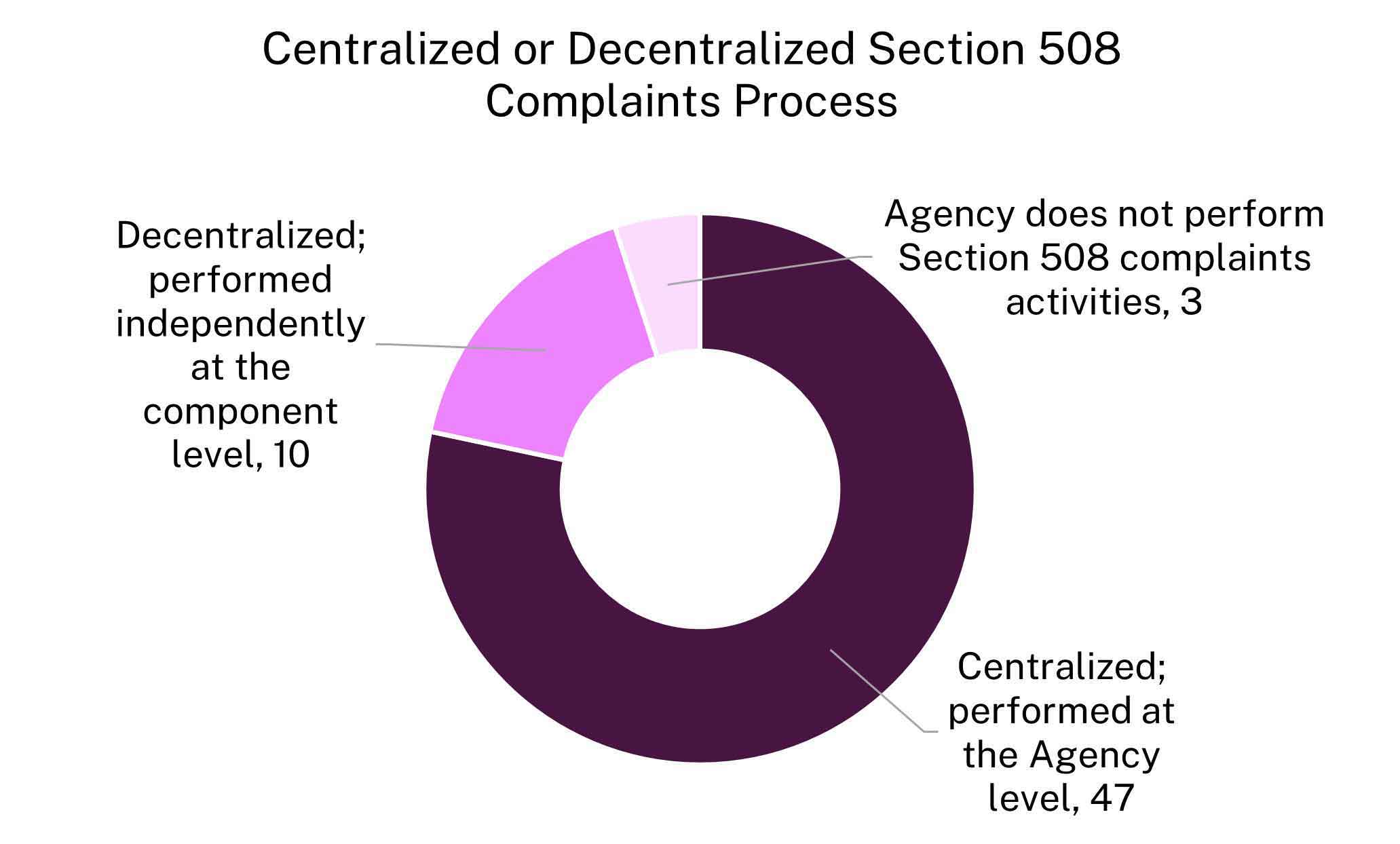
Among the 60 reporting agencies, 47 agencies centralize Section 508 complaint processing at the agency or parent-level, while 10 agencies use a decentralized approach, allowing components to process complaints independently. Three agencies reported that they do not perform any Section 508-related complaint activities. Figure 17 illustrates the distribution of centralized and decentralized complaint processes.
At the component level, 100 components across 10 parent agencies reported that they process Section 508 complaints independently, either as part of a decentralized model or in addition to the parent agency. Of these, three parent agencies reported that they centralize complaint processing, while some of their components also perform the activity independently or in addition to a centralized agency process. This hybrid approach indicates that complaint handling often occurs at multiple organizational levels, increasing the importance of coordination and consistent oversight.
Most agencies have mechanisms to track complaints, but gaps remain. Fifty-one agencies reported having a process to track Section 508-related complaints, while nine agencies reported no tracking process, limiting visibility into complaint trends, resolution timelines, and recurring accessibility issues.
Of the 15 agencies that received Section 508-related complaints within the past 365 days (from agency submission):
Best Practices and Remaining Challenges
Over the past year, some agencies reported progress in advancing Section 508 compliance through targeted Section 508 policy updates, expanded training, and stronger governance structures. Several agencies appointed full-time Section 508 PMs, updated or issued agency-wide accessibility policies, and launched strategic plans to guide implementation. Agencies also expanded internal guidance, including updated Web Content Accessibility Guidelines 2.2 interpretation materials, self-service resources and centralized knowledge libraries. The use of data-driven metrics, dashboards, and early-stage testing practices improved agencies’ ability to identify accessibility issues sooner and reduce downstream defects. Increased role-based training and broader adoption of mandatory courses further supported enterprise-wide awareness and implementation.
Despite this progress, agencies continue to face significant constraints. Limited funding, staffing shortages, and workforce turnover reduce the capacity to conduct systematic testing and sustain institutional knowledge. In decentralized environments, insufficient coordination and staffing at both agency and component levels hinder consistent and effective ICT implementation across the federal government. Agencies also report cultural and governance challenges, including uneven leadership support, limited accountability mechanisms, and difficulty keeping pace with evolving accessibility standards. Without sustained investment, clearer governance, and centralized support, agencies will continue to struggle to scale accessibility efforts and deliver consistently accessible digital services.
Footnotes
- This includes one agency that noted a part-time Section 508 PM but did not have an estimate of time spent and another that input “5–8” hours; five hours was used in the calculation. ↩
- Of the 71 components that had a part-time Section 508 PM, 21 components left the average amount of time spent blank and were not factored in the overall average. ↩
Reviewed/Updated: March 2026